Tagged "google"
-
-
Keep reading →
Chrome Beating Safari: Apple Begs "Please Don't Throw Me in the Briar Patch"
Google Chrome Market Share Surges, Apple’s Safari Dead In Water, Microsoft’s IE Drowning:
The more important story here is potentially that Google's Chrome is gaining share much faster than Apple's Safari. This highlights the power of Google's 'open source' software model, as compared to Apple's integrated hardware-software combo. The software versus hardware/software model, of course, is what doomed Apple in its first battle to the near-death (against Microsoft). So it's worth watching this one closely.
I’m going to return to my point from a couple of days ago instead of savaging the excerpt.
Chrome’s rendering engine is WebKit. That’s an Apple project. Apple took KHTML, spruced it up (such that I know of one Linux site where Konqueror breaks but Konqueror-using-Webkit works), and made it open source. Google liked what it saw and borrowed it for Chrome.
If the author of that excerpt were to be confronted with this fact, he or she might backpedal by pointing out that Apple is a tiny bit open but Google is super-open, and the uptake numbers reflect that. Such backpedaling would require additional politeness on our part, because that’s entirely not the point. The point is this:
It isn’t a bad thing for Apple that Chrome is doing well using WebKit. In fact, it’s a really, really good thing: Apple can continue to serve its customers as it sees fit, Google can continue to serve its customers as it sees fit, and neither has to pay a price for the other’s popularity in terms of the way its customers experience the Web. Both get an outstanding, standards-compliant rendering engine that runs on every major desktop platform, is amenable to being wrapped in a wide variety of toolkits, user agents and form-factors, and helps ensure that we won’t ever have to worry about a single vendor trying to lock the Web up with a bunch of proprietary, non-standard extensions and quirks. Chrome’s gain is every Safari user’s gain and vice versa.
If we want to talk about what in this story is worth watching closely, it’ll be in the ways Apple and Google interact around the WebKit project, and how two companies that are on a collision course in a couple of different spheres (besides the heavily commoditized browser market) manage to relate to each other in a case where they share a mutual interest. Might as well include Adobe in the companies to watch despite bitter disagreements: It uses WebKit to render HTML in Air.
-
-
Google Reader Users?
Using Google Reader? Drop me a line.
#google reader
-
Keep reading →
It's Like an Encyclopedia … Only WEBBY!
If you use iGoogle, I’d sure appreciate it if you’d consider adding and rating the Webopedia iGoogle gadget:
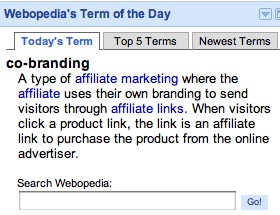Webopedia is an online general computing reference with thousands of definitions and a number of informational pages. It’s actively maintained, so definitions are always being added and the editor is very receptive to corrections or additions from guests. It’s owned by the same company I work for and I took on writing the gadget as a side project for work, so if you’re wondering what my angle is, that’s it.
It’s possible to make Google gadgets using just an RSS feed, but the Webo gadget goes a little further: You get the site’s ’term of the day’ entry along with tabs linking to the most popular and newest terms in the Webo database. You can also search Webopedia from the gadget. I made an effort to keep the gadget clean and minimal, so it loads quickly and there’s not any wasted space.
If you’d like to play with it, here’s an embedded version:
Thanks for taking a look.
#gadgets #google #webopedia
-
-
-