organon has a purpose
I started out wanting a nice skin on an org-inspired list manager and worked my way to something I've wanted for a while.
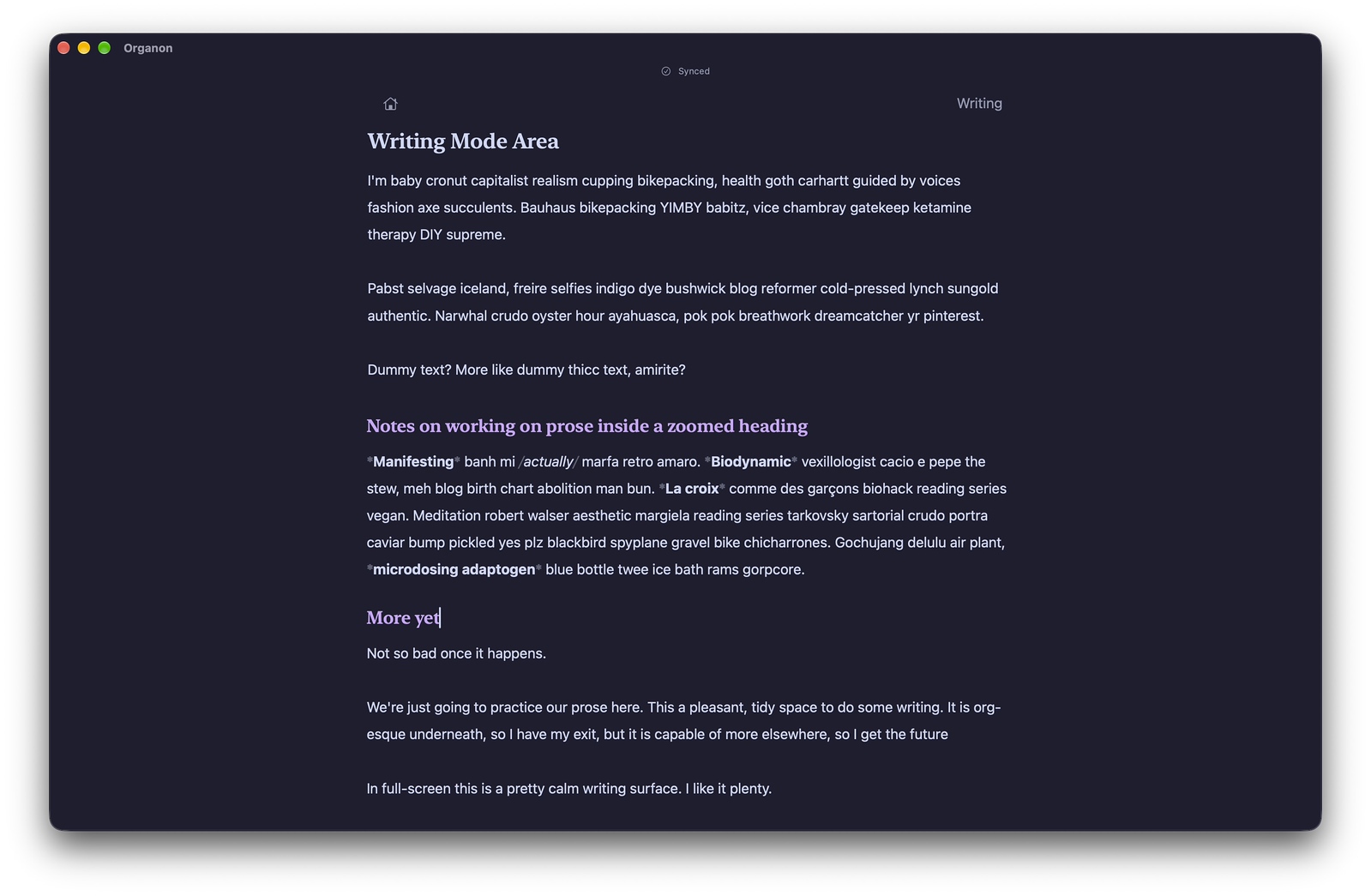
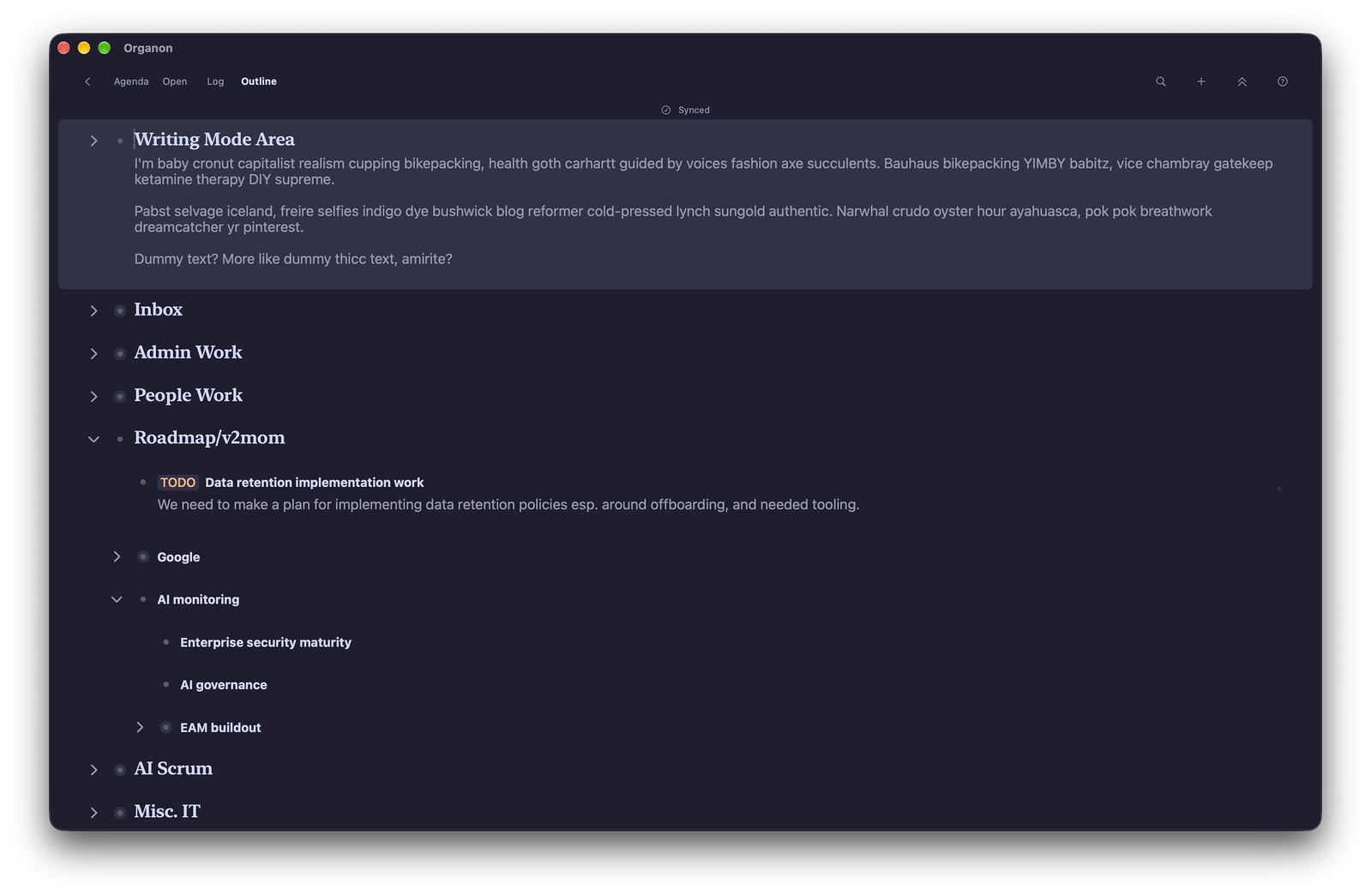
This morning I woke up thinking a bit more about organon and whether it’s something I really want to do. I guess I think a few things:
-
org-mode has been a source of constant fascination for a long time. I already knew to be mad at it in 2010, so I must have been using it for a while at that point.
-
org-mode is my Emacs anchor. I don’t know if I’d have kept a grounding in Emacs if it weren’t for org-mode
-
I hate dealing with Emacs configs. Doom Emacs worked for me for a while because I could do literate config files in org-mode.
-
I hate dealing with the act of running Emacs on a Mac. I think ancient muscle memory collides with the relatively modern (to me) server/daemon stuff.
-
All that goes double for Emacs typography.
-
I love sitting down to iA Writer. It’s a truly lovely writing tool. I don’t use a quarter of its features, I just like the way it feels.
-
org-mode got me to think in outlines in a way nothing else could, because unlike pure outliners, it is okay with mixing in prose in a way that other outliners make feel clunky.
-
org-mode is superior to Markdown. It just is. Markdown is held back by what I guess I’ll call its metadata problem, which is solved by too many cooks in parallel kitchens. I think I know someone who’d say it’s actually its Gruber problem, but when the Pope abdicates, one should expect the assorted cardinals to get their heads together, not form 15 different Opus Dei’s.
-
mobile org-mode implementations on iOS are held back by the platform. Sync is unreliable, and that seems to go triple when you’re trying to sync text vs. structured data.
So I started from “let’s make a PWA that sort of points at org-mode, gives it a nicer, simpler front-end, and can import and export org files even if it doesn’t have the complete syntax.”
That worked great. It was encouraging. So I made a companion iOS app. The two needed to sync, so I made Cloudflare infra to provide a sync engine. Was it bad that suddenly the tool’s native data wasn’t a plain text file? I suppose so? But the plain text is always an export away. So I’m going to allow it.
The next iteration, I realized that we’ve had “nice-looking outliners” for a while. Like OmniOutliner, and that the thing I’ve always prized about org in particular is the way I can dip in and out of outliner, tasks, and prose on one surface, but I’ve never liked trying to strike a balance between the density of the data and how clean I’d like the prose surface to be.
So first I made a Calm Mode that hides all the metadata unless you’re operating on a line with it, and then a Writing Mode that hides all the metadata, takes away some of the heading management affordances, and leaves you with a writing surface that still has structure built into heading handling, but presents much more simply.
So far, so good. Some of this will be offensive to some people, and I’m okay with that, because it’ll be an everyday kind of offense people have been taking over text editors and computers in general for a while.
The next part of the project will be more offensive to more people for different reasons:
The other reason I wanted to run all this from a Worker was because I wanted an MCP for it.
I’ve spent the past 18 months or so working on variations of AI-managed tasks and notes and a bunch of considerations around them.
- I like to share context with agents, both in the form of prose — my thinking about things — and what I’m up to.
- I am very interested in how LLMs can augment how we work, not so much by doing things for us so much as having enough context about us to help us do things.
- I am very interested in how to keep a human (me) in the loop in a way that is efficient and unintrusive.
- I am very interested in figuring out how provenance is supposed to work in any system where AI and human are working in the same space.
My first crack at all this was a set of apps clustered under the name aSystem. It had todos, contacts, notes, an AI-driven task queue, and something called “receptors,” which are behavioral cues for how the task queue should react if it notices, for instance, that a project has gone untouched for a while; or if you haven’t reached out to a human who’s important to you lately.
That was too much at once, and I saw other people working on this anyhow, and it was tough to both tune that system and live in it. So I set it aside in favor of putting softer guards on AI autonomy with my tasks and notes.
Since both are housed in organon, an MCP seemed like a good idea.
So the latest iteration has something for several types of people:
-
For the org-mode purists, it has native Emacs keybindings, same as if you were working from vanilla Emacs. My additions, such as Writing Mode and Calm Mode, go into their own
C-c C-xchords. You can use the more Mac-like ones if you like, but I need to sweep them out and make them rhyme better. -
For the local-first people, there’s native org file vs. the Worker managed cloud db
-
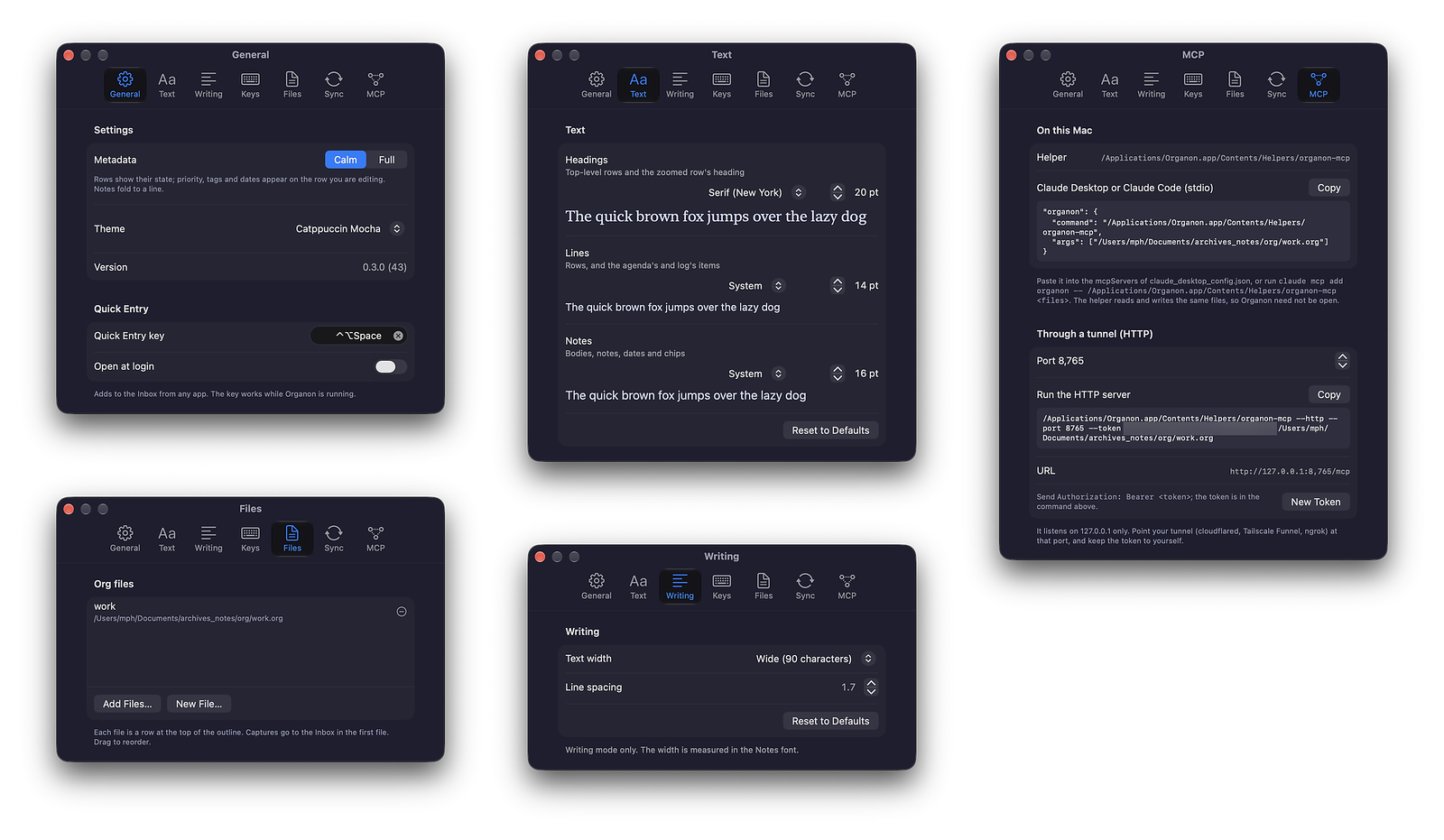
For the AI people, there’s an MCP
For the latter two kinds of people the MCP can operate locally, as well. It has two transports, so if you want to run it on an always-on Mac and add a Cloudflare tunnel to let Claude Desktop or ChatGPT get at it, you can do that.
It’s all still in testing, but I’m using it in anger, and I like it enough that I might start making notarized builds, and I’ll make a product page for it. Addressable market of one, but might as well share.