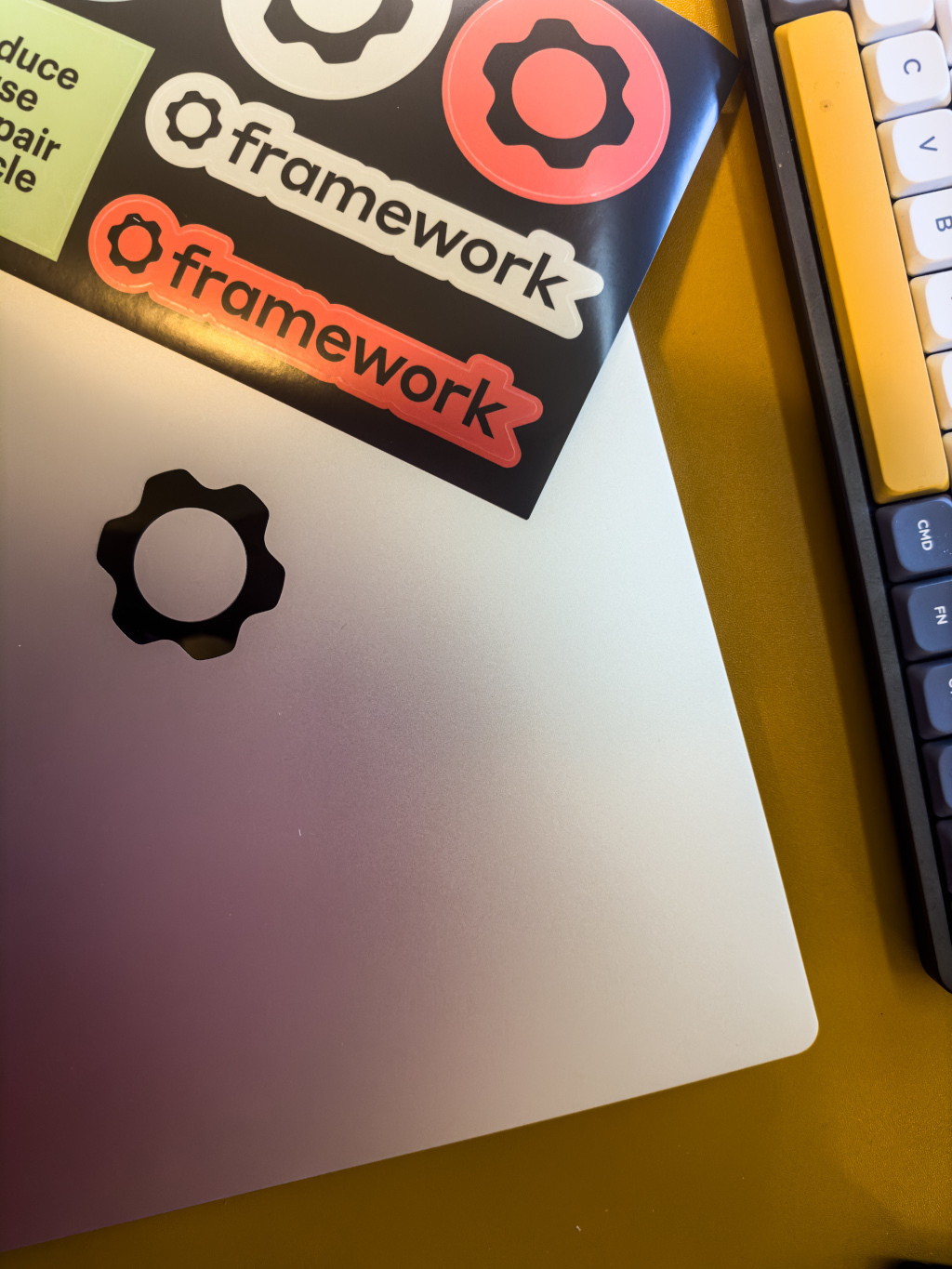
I replaced the 14" MacBook Pro with a Framework 13 running a 13th gen i7. After a little deliberation and an assessment of how much manual intervention I’d have to do during upgrades, I settled on Fedora 38 for it: Barring a single command line intervention to update the driver for the fingerprint scanner, everything worked out of the box. I understand Debian works pretty well on it, but looked a little fussier to set up. Ubuntu is the other officially supported OS, but I’m not interested.
I spent a few weeks circling the reviews and poking around reddit, and though I found a few issues here and there, they tended to be from older reports. The general line on it: That it’s a solid, premium-feeling machine that just so happens to be very repairable, is about right.
When I first heard about Framework, I assumed the repairability would mean a certain clunkiness. That’s not really so. Just to look at it, it bears a striking resemblance to a MacBook Pro. There’s some nice sleight of hand on the profile that gives it a more Air-like look from the sides, but it’s less wedge-shaped across most of the width. It’s 0.01 inches thicker than the 14" Pro, and .7 pounds lighter. There are a few seams because the expansion ports (they offer a bunch, including Ethernet, HDMI, DP, USB A and C) slide in and out of nooks on the side. And because there’s an i7 in there, it sits up on rubber skids to let the machine breath under load.
Hooked up to a charger and running under the “Performance” mode, it gets a little warm and I can get the fans to come on with a lot of activity. You definitely hear them, same as I heard them on my Intel-era 16" MacBook Pro when I did anything in Lightroom. Disconnected from AC, running in the “Power Saver” mode at 50 percent screen, it’s reporting about 9 hours of battery life after close to 2 hours of use browsing around. I have no idea what Darktable would do to that, but I’ll find out soon enough.
I picked the CPU I did after going to a few benchmark sites and comparing it to the M1 Pro in my former 14" MacBook. I wanted something in that ballpark – no more and not much less. The i7 feels fast and smooth – comparable to the Pro – but the difference in heat and battery life is clear. From a “state of the art” PoV, Apple silicon still feels like some kind of alien technology to me. I also considered an i5, but I wanted something that could do more than just stay in the ring if I asked it to pull desktop duty.
Anyhow, simply looking at the Framework in isolation – how it feels to use, and how it performs – it is just smooth and fast, even throttled down. It’s great.
And without getting hostile or shirty about it, I guess I’ll just say there’s things other than those differences. I debated back and forth about continuing to have a “performance laptop” in the house, and the repairability of the Framework decided me. I like the idea of being able to replace the whole mainboard over time, and I love that they sell enclosures for your old mainboard once you decide to replace it.
Building it
I bought the “DIY” edition instead of a prebuilt configuration because I wanted to make my own tradeoffs on CPU, RAM, and storage. That meant it arrived in a few pieces with no pre-installed OS.
I had to install the RAM and SSD, fit the bezel (they’re interchangeable), and connect the trackpad before mounting the keyboard top and screwing down five screws on the underside. I did it at my desk while I was listening to a town hall at work. I put it down long enough to give a five minute talk about my team – I still had the trackpad to go at around the 20 minute mark of cracking open the box – and finished up by plugging in my four expansion modules: 2 USB-C, an HDMI, and a microSD reader while waiting for a few Q&A to come my way. So … less than 30 minutes from opening the box and spreading out the parts to plugging it into the wall and getting it ready for install.
Fedora went on as easily as it has with anything else. Post-install, you have to download and install one thing to get the fingerprint reader to work correctly, and you have to add one grub config change via a single command to get the screen brightness buttons to work. It’s all documented in the post-install instructions Framework offers.
I was considering doing their recommended battery life optimization stuff. They have a very thorough guide to configuring TLP for their hardware. I’d lose the transparency of GNOME’s power management daemon, and even with Linux’s dubious ideas about reported battery life – remaining time bounces around +- 45 minutes now and then – I’m still sitting at 80 percent battery after two hours, so … that seems tolerable for how I work.
So, I’m happy to have this thing. My recent playing around with Linux desktops gave me a view of a way to do computer stuff from day to day that’s sort of leaned out and pared down. If you’d told me some of the stuff going on with GNOME a year ago, I’d have scoffed and said that it sounded a little precious and high-concept. And maybe it is, but it works for me.
And on the other side, I didn’t realize how neurotic I was beginning to feel operating inside Apple’s ecosystem. It just sort of felt like the walls were closing in. The tight alignment and integration induces in me a feeling that if I introduce an alien element to the mix, it all begins to unravel. It was weird to set aside the Apple Watch and feel a sense of relief, because even if I end up thinking iPhones suit me best, I have the option to consider otherwise without orphaning an expensive watch.
I do still like things to talk to each other and interoperate, but another thing to prize in a given ecosystem is interchangeability of the individual parts such that you’re free to figure out where to optimize. Now, look. This can become another kind of neuroticism, and you can see people who run in a certain direction that makes it hard to get anything done because they’ve recursed into hyperoptimizing each node in the graph. That could be me, too.
But it’s been interesting to watch this recent ripple through the Apple people over the idea that iCloud might actually be sort of bad and untrustworthy, because I think some of the religiosity around Apple on the consumer end, similar to the religiosity around Microsoft in the corporate IT world, comes from needing to believe that each new niche of your personal technology ecosystem that Apple fills is best filled by Apple unless you want to leave a lot of integration and interoperability on the table.
Everyone has to find their own balance in this stuff, and there is a certain “doesn’t even think about these things” kind of personality I hold in a little awe for simply not caring about the plumbing, when the people possessed of that personality are simply living good lives and accomplishing things.
But as much as I’d like to demonstrate studied indifference, and as much as tool-fixated people have made my life hard at several stages in my career, I am not indifferent: I like to tinker and play, and on some level Apple makes that kind of hard and maybe a little dull lately.