Mike Gets a Sleep Study
I was up until 2 last night, sitting for part of the time in front of a blank notebook trying to dredge an adequately retrospective mindset for the year past. Part of the time I was actually trying to claim victory over a woodburning stove everyone else in the house had given up on when they went to sleep. I beat the stove, but didn’t really come up with much fodder for talking about last year. 2006 was a fine year. It was nice to go to sleep next to the warmth of the stove, watching the flames dance from behind my closed eyelids to ring it out. That’s all.
On the other hand, Friday night and Saturday morning were spent in a more novel fashion. I had a sleep study done to assess sleep apnea, which I have but which has never been formally diagnosed. We’ve relied instead on the informal observational science Alison has provided with comments like “After your snoring woke me up, I laid there in the gloom of our room and listened to you stop breathing over and over. Are you going to die?”
That’s pretty much sleep apnea: You stop breathing, either because the muscles in your throat lose tone once you’re deeply alseep (obstructive sleep apnea) or because there’s something going on with your central nervous system and your brain just doesn’t tell your lungs to work (central sleep apnea). This doesn’t kill you, but it does cause you to realize that you’re going to suffocate and rouse enough to clear the obstruction, even if you don’t remember doing so the next morning.
I’m pretty sure I’ve got obstructive sleep apnea, because my snoring and breathing have gotten worse as I’ve put on weight over the past several years. Lots of people who are not fat apparently also suffer, but lots of people who wouldn’t have to suffer but who have, like me, gotten fat, suffer needlessly.
I suspect the long-term answer is to lose enough weight that those tissues in my throat quit blocking my airway when I’m not awake enough to keep them open, allowing me to breathe freely and not become a walking, talking parable for the good life suffocating in the folds of its own throat-flesh. I’ve always been a mild snorer, though, and waking up with a painfully dry mouth and feeling under-rested after being conked out for 12 hours straight are things I remember doing when I was running six miles a day and weighed 190 pounds in my ugly brown army underwear. The short term answer is usually a thing called a “CPAP,” which is a device that goes over your nose, forces air through it, and keeps the airway open. For people who have the issue with their brain regulation, the answer is similar to a CPAP, except they’re kept breathing when their natural respiration drops off.
Getting the study done was easy to initiate. My doctor listened to me describe a few symptoms, issued me some steroid nasal spray to see if that helped, then ordered the sleep study in case it didn’t.
I reported to the hospital on Friday night with my favorite pillow, some pajamas and a couple of books. I was put in a private room that was done up to be as pleasant as a hospital room can be (lit less pleasantly than the one Alison had Ben in, but with a real bed and some Van Goghs that were supposed to help me sleep, perhaps by comparing my own somewhat pleasant and uneventful life with the tortured one poor Vincent led. I mean … who would really want to sleep if they thought all those stars were up there THROBBING?
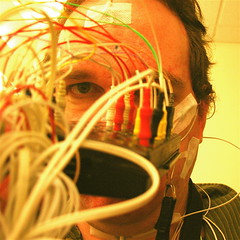 The sleep tech wired me up over the course of nearly an hour. I got sensors run down my pajama pants and attached to my shins, more sensors glued to my chest, a bunch glued to my head, one clamped on the end of my finger, another one taped under my nose and a few stuck on my jaw. Oh … and two bands – one around my abdomen and another around my chest – which had the unpleasant effect of making me look and feel squished.
I watched an informative video while the wiring was going on. One part of it featured a dramatization of a sleep apnea sufferer who pretty much hit all the symptoms: snored, sleepy to the point of napping at his desk, never feeling rested, always feeling exhausted, irritable, etc. etc. etc. Then there were interviews with real sleep apnea sufferers, including a gray-faced charmer who said he was glad he got help because he was tired of making his wife sleep on a cramped couch thanks to his snoring. I muttered “fucker” under my breath at him, and the tech laughed nervously so I clarified that it seemed unjust for the wife to be the one getting booted out of bed.
The wiring was all fed into a sort of junction box with a strap, which was hung around my neck until it was time for me to go to bed. The purpose of all the wiring was to monitor my heart rate, my blood oxygen level, my sleep state, REM, leg movement, and the volume of my snoring. They also trained a night-vision camera on me. I thought it was funny that the Catholic hospital had Jesus on a cross right underneath the camera. What they were looking for most specifically were “respiratory events,” where they can monitor an appreciable stop in breathing or enough apparent obstruction that my snoring becomes indicative of someone trying hard to force air through an obstructed airway.
There was a calibration phase, where I clinched my jaws and flexed my feet and moved my abdomen while holding my breath so the tech could make sure I was properly wired up. Lights out was at 11:00 p.m. … just two hours after I’d arrived, and with only a few minutes to myself to get ready for bed and do a little reading. Since I was supposed to do what I do at home, getting ready for sleep involved two trazodone and a small dose of melatonin. I could tell I was sort of excited because even laboring under all that it took a good 20 or 30 minutes to finally sleep.
Anyhow, according to the tech, the severity of one’s sleep apnea is measured by how many respiratory events per hour one has. They consider 20 per hour a problem and will then move into a portion of the test where they use a CPAP and see what would be required to correct the apnea using one of those. So he had me go to sleep promising me that if I hit the magic number of 20 respiratory events per hour, he’d be in to fit the CPAP and let me go back to sleep. I think that kept me up, too. I mean, I want to lose the weight I need to lose to lessen my snoring, but I don’t want to do it so precipitously that I hurt myself that way. So as much as I enjoyed getting wired up and knowing that I was going to be measured more closely than normal, I felt a strange sort of pressure to produce a lot of respiratory events so they could render a verdict, prescribe me a CPAP and let the problem be fixed at least temporarily while my new gym membership starts to go to work for me.
I was roused once because I kicked off one of the leg sensors in the night, then I was roused again because I’d rolled over on my hand and was messing up the sensor that told them my blood oxygen levels. Each time it briefly occurred to me to ask something like “how’m I doin’? Am I really and truly strangling on my own floppy throat?” but it seemed somehow gauche and perhaps unscientific. So I kept my mouth shut and stirred a few more times in the course of the night waiting to be roused and told I Had a Problem That Could Be Fixed with Technology. I didn’t want to wake up at dawn and be sent on my way as an apnea failure.
The tech finally came in and said “Well, you’ve definitely qualified for the CPAP,” but he didn’t go into any details. He fitted me with a mask that fit over my nose and started the machine, which did what it’s supposed to … it blew a gentle breeze, lightly latex scented, up my nose and made talking a strange exercise in realizing how light our speaking breaths are and how hard it is to speak when there’s a sudden breeze in your head.
I went back to sleep and stayed that way until 6 a.m. when I was roused and given a clipboard to fill out asking me things like “how many times do you remember waking up?” and “do you feel more or less rested than normal?” I was supposed to just get dressed and be let out, but I was really curious about just what the whole process was and just how, you know, Badly I Had It.
The tech was friendly and he let me into the control room and showed me some of what was being tracked over the course of the evening. He did some quick calculations for his own report and said I had an average of 57 respiratory events per hour, which qualifies me to freight the number with excessive significance when discussing it with friend and stranger alike:
“57,” I’ll say. “It’s a real problem at twenty!”
Then I’ll pause for some water, let it sink in, and look a little frightened but determined … I’m gonna lick this problem of excessive throat flab with steely resolve and a thing that goes over my nose and blows air up it, and probably an emphasis on sensible diet and regular exercise.
One other data point that came out of the evening was the observation that I was so busy nodding off, choking on my own throat, waking up, and nodding off that I didn’t go into REM at all until the second half of the evening, when I got the CPAP hooked up. Then one of my REM stages lasted 45 minutes instead of the normal 15-30. The tech called that “REM rebound,” and I guess it’s common.
After looking at a lot of squiggly lines that showed my heart rate spiking appreciably during events, other squiggly lines showing my blood oxygen level dropping to low levels (I don’t understand the numbers I was given yet, so I won’t try to explain them and they’re no good for my “noble sufferer” schtick), I was given a form informing my doctor of the basic finding, which is that I need a CPAP machine, then I was sent on my way.
I sat in the hospital parking lot waiting for the car to warm up, listening to the early details of Saddam Hussein’s execution. Then I drove home to Al and Ben.
So … CPAP for me in the next week or two.
I’ve got a part two in here somewhere, but I figure I’ll save it for once I’m getting the breeze shot up my nose in the comfort of my own home.